
Over the ages, India has conjured up different images at different times, but one
constant through the centuries has been its textiles and one region, which
has always been in the picture in this regard, has been Tamil Nadu.
Early records speak of fine muslin and silks and hand painted calicos that the Greeks came to buy from Tamizhagam, the home of Tamil. Uraiyur/Karur and Madurai, situated close to the cotton fields, were major centres of weaving. They still are the most prominent centers for the exquisite weaving products.
 Weaving was a highly regarded profession. It is said the Chola princes wore
only cotton. The king's robe was of quilted cotton, with a garment worked
with gold. Soldiers also used quilted cotton fabrics.
Weaving was a highly regarded profession. It is said the Chola princes wore
only cotton. The king's robe was of quilted cotton, with a garment worked
with gold. Soldiers also used quilted cotton fabrics.
The raw materials used in the silk weaving centres are not indigenous to Tamil Nadu for 'Zari' comes all the way from Surat while neighbouring Karnataka supplies the silk. Indeed Karnataka meets the silk needs of not just Kanchipuram but the whole of India.
Tanjavour is well known for its cotton weaving with several centres around the state. Cotton has long been the mainstay of the textiles of Tamil Nadu and one sees a wide range here. Madurai and Salem specialise in fine gold-bordered Dhotis, with Madurai's Dhotis considered a little superior in their weaving and Zari to those of Salem.
From the coarse Chettinad saris (also spelt as sarees), to the saris of Salem, Rasipuram and Coimbatore, to the fine gold bordered muslins of Madurai or its more recent medium weight reasonable saris that are printed or resist-dyed and are popularly referred to as the "Madurai Sungudi", the weaves of Tamil Nadu offer wide choices.
The Chettinad saris are mainly mustard, brick red and black, of 91 cms width instead of the standard 120 cms of other regions, which reach only till the calves to allow the women to display their anklets.
The State has also emerged as one of the leading producers of household furnishings and linen and contributes a significant share to the textile exports of India. One sees the weaves of Karur in some of the best stores of the world.
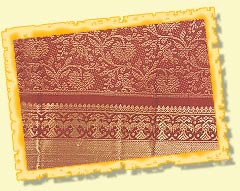
Kanchipuram is famous for its silks. As the vast range of cottons are not withstanding, these textiles are overshadowed by their glamorous counterpart, the silks and more specifically those from Kanchipuram.
Research suggests that silk was a new entrant into Kanchipuram, for till a century and a half back, Kanchipuram was primarily a cotton-weaving centre. It was the Thanjavur -Kumbakonam belt and 'Arni' along with Salem that produced the "Pattu Pudavai" Today the finer, better-woven and more expensive silk saris are from Kanchipuram.
Kanchipuram silk saris are woven in two parts. The Pallu-and-border are woven as one unit and attached to the body of the sari, which is woven separately. The motifs used are derived from traditional temple architectural forms. Specialising in heavy weight "Murukku Pattu" the weaves of Kanchipuram weave three ply, high denier threads, using thick Zari threads for supplementary warp and weft patterning. The main characteristic of this sari lies in the time consuming method of interlocking its weft colours as well as its end piece and in the process creating solid borders and a solid 'Mundhi' (end pieces). If well done one hardly sees where one colour ends and the other begins.
Over the years inputs from weavers, designers and the weaver service centres have led to an increasing variety of designs and colours and created a special market niche for the Kanchipuram silks.
Thanjavur is another silk center, which specialises in the use of Zari and brocade work. These saris are heavy and opulent. Thanjavur and Kumbakonam create saris similar to Kanchipuram but the Mundhi or end pieces are finished differently. Using a technique called "Porai" the weavers pull the warp threads, at the join of two colours, into loops at the back and then cut it close.
Arni, a town near Kanchipuram, produces light silk, often shot fabric, mainly in checks of orange and red. This town once wove very expensive silks but now concentrates on single colour lightweight textiles with zari borders and zari 'Pallus'. But with increasing labour costs pushing up the prices of Kanchipurams, Arni is slowly coming into its own with attempts to weave the Kanchipuram at competitive prices.
Tamil Nadu silks are long lasting. Traditionally, they were washed by being beaten on a granite stone (it is so even today in many homes) and they survived many a generation.
History
Early records speak of fine muslin and silks and hand painted calicos that the Greeks came to buy from Tamizhagam, the home of Tamil. Uraiyur/Karur and Madurai, situated close to the cotton fields, were major centres of weaving. They still are the most prominent centers for the exquisite weaving products.
Weaving was a highly regarded profession. It is said the Chola princes wore
only cotton. The king's robe was of quilted cotton, with a garment worked
with gold. Soldiers also used quilted cotton fabrics.Raw Material
The raw materials used in the silk weaving centres are not indigenous to Tamil Nadu for 'Zari' comes all the way from Surat while neighbouring Karnataka supplies the silk. Indeed Karnataka meets the silk needs of not just Kanchipuram but the whole of India.
Wide Range Of Textiles
Tanjavour is well known for its cotton weaving with several centres around the state. Cotton has long been the mainstay of the textiles of Tamil Nadu and one sees a wide range here. Madurai and Salem specialise in fine gold-bordered Dhotis, with Madurai's Dhotis considered a little superior in their weaving and Zari to those of Salem.
Tamil Nadu Arts
From the coarse Chettinad saris (also spelt as sarees), to the saris of Salem, Rasipuram and Coimbatore, to the fine gold bordered muslins of Madurai or its more recent medium weight reasonable saris that are printed or resist-dyed and are popularly referred to as the "Madurai Sungudi", the weaves of Tamil Nadu offer wide choices.
The Chettinad saris are mainly mustard, brick red and black, of 91 cms width instead of the standard 120 cms of other regions, which reach only till the calves to allow the women to display their anklets.
The State has also emerged as one of the leading producers of household furnishings and linen and contributes a significant share to the textile exports of India. One sees the weaves of Karur in some of the best stores of the world.
Kanchipuram Silks
Kanchipuram is famous for its silks. As the vast range of cottons are not withstanding, these textiles are overshadowed by their glamorous counterpart, the silks and more specifically those from Kanchipuram.
From Cotton To Silk
Research suggests that silk was a new entrant into Kanchipuram, for till a century and a half back, Kanchipuram was primarily a cotton-weaving centre. It was the Thanjavur -Kumbakonam belt and 'Arni' along with Salem that produced the "Pattu Pudavai" Today the finer, better-woven and more expensive silk saris are from Kanchipuram.
Kanchipuram silk saris are woven in two parts. The Pallu-and-border are woven as one unit and attached to the body of the sari, which is woven separately. The motifs used are derived from traditional temple architectural forms. Specialising in heavy weight "Murukku Pattu" the weaves of Kanchipuram weave three ply, high denier threads, using thick Zari threads for supplementary warp and weft patterning. The main characteristic of this sari lies in the time consuming method of interlocking its weft colours as well as its end piece and in the process creating solid borders and a solid 'Mundhi' (end pieces). If well done one hardly sees where one colour ends and the other begins.
Over the years inputs from weavers, designers and the weaver service centres have led to an increasing variety of designs and colours and created a special market niche for the Kanchipuram silks.
Thanjavur And Kumbakonam Silks
Thanjavur is another silk center, which specialises in the use of Zari and brocade work. These saris are heavy and opulent. Thanjavur and Kumbakonam create saris similar to Kanchipuram but the Mundhi or end pieces are finished differently. Using a technique called "Porai" the weavers pull the warp threads, at the join of two colours, into loops at the back and then cut it close.
Arni - Centre Of Silk Fabrics
Arni, a town near Kanchipuram, produces light silk, often shot fabric, mainly in checks of orange and red. This town once wove very expensive silks but now concentrates on single colour lightweight textiles with zari borders and zari 'Pallus'. But with increasing labour costs pushing up the prices of Kanchipurams, Arni is slowly coming into its own with attempts to weave the Kanchipuram at competitive prices.
Tamil Nadu silks are long lasting. Traditionally, they were washed by being beaten on a granite stone (it is so even today in many homes) and they survived many a generation.