
Monuments & Temples in Kerala
Bekal Fort :
- Location - Bekal, Kerala
- Built By - Sivappa Naik
- Built In - Around 1650 A.D.
- Unique Feature - Largest Fort In Kerala India Tourist Guide.
Bekal fort, which is the largest and the best-preserved fort in Kerala is the most important monument of the region. This fort, located on the highway, is believed to have been built in the 1650's by Sivappa Naik of the Ikkeri dynasty. Later it was transferred to Hyder Ali of Mysore and then to the British.
The sea bastions, underground tunnels and the observation tower are impressive. An old mosque is situated very near the fort, which is believed to be built by Tipu Sultan. History sleeps here among the lonely battlements of the Bekal Fort by the sea shore.
This landscape of ethereal quality, its never-ending grasslands and sea views possess all the potential to be developed into a superb tourist destination. The Bekal fort is located on a vast 35-acre headland that runs into the Arabian Sea. Click here for Fort Tours in Kerala
This imposing structure of laterite rising 130 ft. above sea level has a chequered history of 300 years ,which adds to its interest as an archaeology site. Due to its historic relevance, the fort is controlled by the Archaeological Survey of India.
Nearby Attractions :
Pallikere Beach - The Pallikere beach, which is a beautiful expanse of shallow waters and beach is fast developing as a tourist destination. Providing ample scope for recreation and relaxation, the beach affords a scenic view of the Bekal Fort.
The Bakel Aqua Park - Located north of Bekal fort, The park, the only one its kind in Malabar, offers boating facility in the backwaters near the Pallikere beach. Facilities for pedal boats and water cycling provide perfect recreation on the cool stretches of the Bekal Hole backwaters.
Edakkal Caves :
- Location -Ambukuthi Hills, Wayanad
- Built By - One Of The Earliest Centres Of Human Habitation
- Built In - F. Fawcett
- Unique Feature -World's Richest Pictographic Gallery of its kind
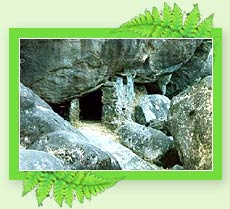
Situated on Ambukuthi Hills, Edakkal caves are 10 kilometers from Sultanbathery, in Wayanad district. Formed by a large split in a huge rock, the two natural rock formations represent the world's richest pictographic gallery of its kind. The two caves located at a height of 1000m on Ambukutty Mala near Ambalavayal can be accessed only by a 1 km trek trail from Edakkal. Edakkal literally means 'a stone in between'.
It is a prehistoric rock shelter formed naturally out of a strange disposition of three huge boulders making one to rest on the other two, with its bottom jutting out in between and serving as the roof. Edakkal rock engravings stand out distinct among the magnitude of prehistoric visual archives of paintings and graphic signs all over the world.
Archaeological Evidence :
Archaeologists consider these as one of the earliest centres of human habitation. It is believed that similar straight-line cave drawings that are considered 7000 years old can be seen only in Stiriya in the European Alps and a few rocky places in Africa.
The pictures depict the moods of man and woman, stars, bow, knife, palm etc. ancient carvings and pictorial wall inscriptions of human and animal figures with peculiar head-dresses and swastik forms and other geometric symbols. The caves contain several paintings and pictorial writings of the New Stone Age Civilization, which speak volumes of the bygone life and civilization.
The Discovery :
F. Fawcett, the then Superintendent of Police, who was also a pre-history enthusiast, accidentally discovered the caves.
Fawcett went around exploring the Wayanad high ranges, which eventually led to the discovery and identification of the Edakkal rock-shelter in 1894. He identified the site as a habitat of Neolithic people on the basis of the nature of representations on the cave walls, which appeared to him as engravings made of neolithics celts.
Guruvayoor Temple :
- Location -29 Kms North-West Of Thrissur, Kerala
- Popularly Known as - Dwaraka of the South
- Dedicated To- Lord Krishna
- Significance-Most Important Hindu Pilgrim Centre in Kerala
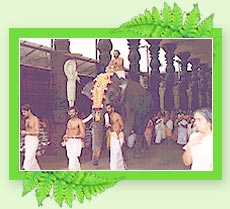
Guruvayoor, where the famous Sree Krishna Temple is situated, is one of the most sacred and important pilgrim centres of kerala. The walls of the sanctum sanctorum are inlaid with exquisite mural paintings and carvings. In Kerala, this is probably the only temple that hosts the maximum number of marriages and rice feeding ceremonies (the ritual first meal for infants).
It was also the hub of the 'Guruvayoor Sathyagraha', a historic movement demanding temple entry rights for the 'so called' lower castes. The historic temple is shrouded in mystery. According to local belief, the temple was created by 'Guru', the 'preceptor of the gods' and 'Vayu', the 'god of winds'. The eastern 'nada' is the main entrance to the shrine. In the 'Chuttambalam' (outer enclosure) is a 33.5-m tall gold-plated 'Dwajastambham' (flagpost). There is also a 7 m high 'Deepastambham' (pillar of lamps), whose thirteen circular receptacles provide a truly brillant spectacle, when lit.
The square 'Sreekovil' is the sacred sanctum sanctorum of the temple, housing the main deity. Within the temple, there are also the images of Ganapathy, Sree Ayyappa and Edathedathy Kavil Bhagavathy. Only Hindus are allowed inside the temple. Punnathoorkotta, which is at a distance of 2 kms from Guruvayoor is home of 50 temple elephants, offers unusual spectacles of the gentle pachyderm.
Timings :
The temple is open 03:00 am to 01:00 pm & 04:30pm to 08:30 pm. It then proceeds to Thriprayar, Koodal Manikyam, Vadakkumnathan Temple, Chettuva and returns to Guruvayoor by late evening.
How to go to Guruvayoor :
Air - Nearest international airport is at Nedumbassery (87 km).
Road - The place is well connected to neighbouring places by good motorable roads.
Napier Museum :
- Location -Thiruvananthapuram, Kerala
- Also Known As -Government Art Museum
- Designed By - English Architect, Chisholm
- On Display-Life-Size Statues Of Kathakali Dancers
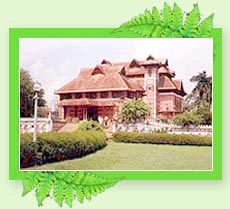
An architectural splendour, the Napier Museum combines traditional Kerala style with the Chinese and Mughal influences much evident in its architecture. The 19th century English architect, Chisholm, designed the building, which houses a rare collection of archaoelogical and historical artifacts. The museum housed in a whimsical building dating from 1880, displays an assortment of bronzes, historical and contemporary ornaments, temples carts, ivory carvings and life size figures of Kathakali dancers in full costumes.
The interiors of the Indo-Sarcenic structure are every bit as intriguing as the exterior with pink and blue stripes alternating with stripes of yellow and cherry red, scalloped arches of a banana yellow, interpreting elaborately carved balconies, the whole linked together with red and white lattice work and mock friezes. The building boasts of a natural air conditioning system. Nearby, there is the Natural History Museum, first opened in 1857, that has a collection of ethnographic pieces, animal skeletons and stuffed animals and birds.
Timings :
The museums are open from Tuesdays to Sundays from 10 a.m. to 4.45 p.m. On Wednesdays, the museum opens only at 1 p.m.
- The driver Krishna was outstanding, polite, well-dressed and very patient. The road conditions were hazardous at times, but he negotiated them very capably. This is the second time I have used your company and I am extremely satisfied with your service. I will continue to recommend your company to colleagues visiting India and will be in touch for my next trip.......said Randy Bindra, USA travelled through us from 04 Mar. to 09 Mar. 2013
- We would like to thank you and your colleagues for a very well organised three week holiday. We thoroughly enjoyed it and everything worked very well. The overnight on the houseboat was a wonderful experience, it was such a change from being on the busy road, and to have the peace, silence and tranquillity for nearly 24 hours was indeed very nice. So, we can also recommend that and the two crew were very good indeed, and we thoroughly enjoyed the meals they provided for us. It was really good experience..........said Ketty Tomes, UK travelled through us from 28 Jan. to 17 Feb. 2013
- Thank you very much for great trip in India. My 4th trip to India has made that I’m more addicted to India than I was before (I thought that I couldn’t be more addicted but I was wrong). I tell only positive things to all my friends about my trip and TSI. Maybe my girl friend decides to visit South India with 3 other girls. I also look forward to visit Ladakh and Kashmir.........said Robert, Poland travelled through us from 29 Jan. to 13 Feb. 2013
- Dear Manoj,
Everyone is safely home again after our spice discovery tour, and we can definitely consider it one of our successes. Once again you won everyone’s hearts with your thoughtfulness and thoroughness in all our activities. I don’t know how we would have coped with the flight cancellations between Udaipur and Madurai if you had not been there to sort it out! ..............said Liz and Ian, Australia travelled through us from 13 Jan. to 29 Jan. 2013 - Dear Manoj,
Our tour of your wonderful country was fantastic. I was returning, after 36 years, but it was Helen’s first time and she loved every minute of the amazing journey. Our precious eighteen days seemed to stretch—there was so much to see and do! Each night we went to bed tired, and occasionally exhausted. And so, we really appreciated the extra effort made by all the Indian hotels to provide us with additional length in our double beds. Thanks you for making those arrangements. We were always very comfortable at night so we woke up refreshed, ready to enjoy the delights of the next day.........said Helen & Richard Walker, Australia travelled through us from 13 Jan. to 29 Jan. 2013 - We just want to thank for the amazing service provided to us. We are very happy and impressed with all assistance and support you gave us during the whole trip......said Manha Cleusa, Brazil travelled through us from 22 Oct. to 02 Nov. 2012
- We have enjoyed our trip to India and will certainly recommend TSI to any friends who wish to visit your beautiful country.....Dr. Chanvit, Thailand travelled through us from 11 Feb. to 20 Feb. 2012
India Tour Packages