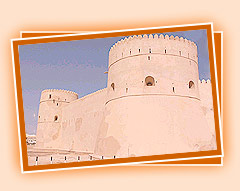
Monuments in Karnataka
Badami Caves
About
Badami Caves :

The capital of the Early Chalukyas, Badami is picturesquely situated at the
mouth of a ravine between two rocky hills, Badami is famous for its cave
temples - all hewn out of sand stone on the precipice of a hill.
Badami is an interesting place to visit in Karnataka what with its
artificial lake, ancient temples, Museum and Hindu and Jain caves carved in
the Sandstone hills. The largest and most ornamental is the third cave
temple dedicated to Vishnu.
Overlooking the cave temples is a reservoir dotted with temples dedicated
to Vishnu and Shiva. Also a must are the Bhutanath temples that lend their
name to the lake beneath the cave temples. The main attractions of Badami
are the caves found there.
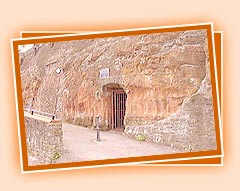
The caves found here are :
Cave 1 - The first cave made of red sandstone, dates back
to 578 A.D. and was probably the first to be carved. One has to climb up 40
odd steps to reach the colonnaded verandah, a hall with numerous pillars and
a square shaped sanctum hollowed in the control back wall. Column shafts are
masterfully crafted. On the ceiling one can see the paintings of amorous
couples. Shiva and his consort Parvati, and a coiled serpent. The 18-armed
lord Nataraja can be seen in 81 dancing poses.
Cave 2 - Dedicated to lord Vishnu depicted here as a
dwarf or 'Trivikrama' of awesome dimensions with one foot mastering the
Earth and the other the sky, the second cave is atop a sandstone hill.
Vishnu here is depicted as a dwarf or. Another form of Vishnu portrayed here
is as 'Varaha' or as a boar. Then there is a frieze endearingly depicting
Vishnu as Lord Krishna.
Cave 3 - Still going higher up one comes across this cave
antedating 578 A.D. The facade of the cave is nearly 70 feet wide, on the
plinth one can see the carvings of ganas. The sheer artistry and sculptural
genius makes this cave the highlight of Deccan art. It gives a virtual
insight into the art and culture of the 6th century like costumes, jewelry
hairstyle lifestyle etc. The other attractions to be looked carefully in
this cave are the high relief of Vishnu with a serpent, Vishnu as Narasimha
(Vishnu as Man-Lion) Varaha, Harihara (Shiva Vishnu) and Vishnu as
Trivikrama.
Cave 4 - The only Jain cave, the construction of Cave
four started in the 6th century and completed after nearly 100 years later
then the earlier three caves. Here one can see the carvings of the
Tirthankara Parshavnatha with a serpent at his feet; Mahavira in a sitting
posture also can be seen in the shrine.
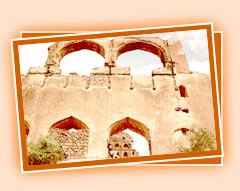
Bidar Fort
About
Bidar Fort :

In medieval times Bidar belonged to the Chalukyan branch who established
their capital in 977 A.D. at Kalyani, 57 kms away. Falling to the Yadavas of
Devagiri (Daulatabad) and to the Kakatiyas of Warangal in 1322 A.D., Bidar
fully rose to prominence under the sultanate regime.
The imposing fort of Bidar is a magnificent fort, the main gateway of which
was originally built by Bahamani Sultan Ahmad Shah Wali in 1429 AD. Further
improvements to the citadel were carried out by the Barid Shahi Sultans.
Ahmad Shah Wali (1422 - 35) the ninth Bahamani Sultan decided to shift his
capital from Gulbarga to Bidar for reasons of health.
Palaces, pavilions and seraglios; lush gardens, decorated fountains and
perfumed baths have all the trappings of an Arabian Nights fantasy when
Bidar was ruled by the Bahamanis and the Barid Shahi Sultans of the Deccan.
Sprawled on a plateau 2,200 feet above sea level and overlooking the
Manjira River Valley, cool and exhilarating Bidar was most certainly a part
of ancient Vidharba mentioned in the Mahabharata.
How to get there ?

This place is accessible by Rail and Road.
Bull Temple
About
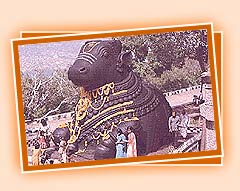
Bull Temple :

The Bull Temple situated in Bangalore , houses the 4.57 m high and 6.10 m
long image of Nandi, Lord Shiva's bull. The temple was built by Kempe Gowda
in the 16th century. The image has been carved out of single granite rock.
The original colour of Nandi bull was grey which has now turned black due
to the application of coconut oil by the devotees. The statue of the bull
has been carved out of a The single rock statue attracts devotees from far
and near. Non Hindus are not allowed in the temple.
The temple is busy always with some ceremony that is on all the time at the
temple premises. On weekends, musicians present their concerts at the
temple.
Gulbarga Fort
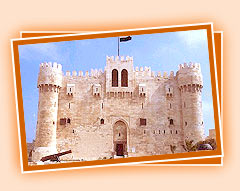
About Gulbarga Fort :

Gulbarga fort, originally built by Raja Gulchand was later strengthened by
Ala-ud-din Bahmani. The fort contained 15 towers and 26 guns of which one
was 8 metres long. Within the ramparts of the fort, there is an imposing
mosque, which resembles the great mosque of Cordova in Spain.
This mosque is the only one of its kind in the entire country. Several
tombs of the Bahmani Sultans can be found in the eastern outskirts of the
town. The imposing fort of Gulbarga has witnessed many a battle and suffered
many an onslaught. Razed to the ground by Krishna Devaraya of Vijaynagar, it
rose like a phoenix when Adil Shah undertook its repair with booty captured
from Vijaynagar.
How to get there ?

Gulbarga is connected by rail and road facilities with almost all the
important towns and cities in the state.