
A Specimen Of Kakatiya Architecture :

4-km
from Hanumakonda crossroad in Warangal district is the Thousand Pillar
Temple, a fine specimen of 'Kakatiya' architecture and sculpture. It is the
main attraction of Hanamkonda. The temple was built by 'Rudra Devi' in 1163
AD.
The temple is in shape of a star and has three shrines dedicated to Lord
Shiva, Vishnu and Surya. The temple is built on a 1m high platform on the
slopes of the Hanumakonda hill, and has a majestic monolithic Nandi. The
black basalt Nandi, a monolith, has a lovely polished finish.
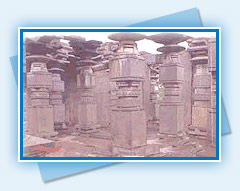
There are many small lingam shrines surrounding the gardens. The temple is
famous for its richly carved pillars, screens and detailed sculpture. The
atmosphere is calm and serene with the sonorous ringing of the puja bells,
gentle chirping of the birds and the soothing cool breeze.

How to get there ?
Air - The nearest airport is at Hyderabad , 157-km away.
Rail - Warangal has a railway station and is well
connected by rail to important cities of India.
Road - APSTRC and Private buses connect Warangal with
Hyderabad, Vijayawada, Karimnagar, Khammam and some other districts.
Tirupati
- A Divine Destination :

Tirupati City is located in the southeastern part of Andhra Pradesh State.
It lies about 152-km northwest of Chennai in the Palkonda Hills. Tirupati is
known as the abode of the Hindu god Venkateshvara (also spelt as
'Venkatesvara'), "Lord of Seven Hills". About 10-km northwest of
Tirupati, at an elevation of 750m, is the sacred hill of Tirumala, which was
considered so holy that before 1870 non-Hindus were not permitted to ascend
it.
Back To History - The Ruling Dynasties :

Tirupati was developed mainly by the contributions made by kings during
their rule. Almost all the kings from great dynasties of the southern
peninsula have paid homage to Lord Sri Venkateswara in this ancient shrine
of Tirupati. The Pallavas of Kancheepuram (9th century AD), the Cholas of
Thanjavur (a century later), the Pandyas of Madurai, and the kings and
chieftains of Vijayanagar (14th - 15th century AD) were devotees of the Lord
and they competed with one another in endowing the temple with rich
offerings and contributions.
During the rule of the Vijayanagar dynasty contributions made to the temple
increased enormously. Krishnadevaraya had statues of himself and his
consorts installed at the portals of the Tirupati temple, and these statues
can be seen to this day. There is also a statue of Venkatapati Raya in the
main temple at Tirupati.
The decline of the Vijayanagar dynasty did not affect the contributions to
this place as many nobles and chieftains from all parts of the country
continued to pay their homage and offer gifts to the temple. Raghoji
Bhonsle, the Maratha general, visited the temple and set up a permanent
endowment for the conduct of worship in the temple. He presented valuable
jewels to the Lord, including a large emerald, which is still preserved in a
box named after the General. Among the later rulers who have endowed large
amounts are the rulers of Mysore and Gadwal.
After the fall of Hindu kingdoms, came the Muslim rulers of Karnataka and
after their downfall the British took over, and many of the temples came
under their supervisory and protective control.
In 1843 AD, the East India Company divested itself of the direct management
of non-Christian places of worship and native religious institutions.
How to get there ?
Air - Direct flights to Tirupati are available from
Hyderabad and Chennai only.
Rail - Tirupati is the nearest railway station. There are
trains that travel via Renigunta or Gudur, but do not touch Tirupati. In
such cases, Renigunta or Gudur, are convenient points to alight. From
Renigunta / Gudur one can reach Tirupati by train, bus, or taxi.
Road - APSRTC buses run from all the important places in
the state and between Tirupati and Tirumala. TTD also runs buses between
Tirupati and Tirumala, free of cost.