Andhra Pradesh, the symbol of true spirit of Indian secularism where people of all faiths -Muslim, Buddhist and Hindu form a symphony of religions. History has forged, and left behind vital links with the state, as is evident from the many edifices, monuments and architectural ruins, the legacy of dynasties as old as 300 B.C.

Forts and Monuments of Andhra Pradesh
Charminar
-
About Charminar
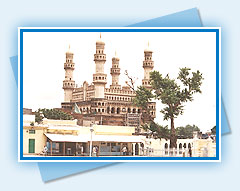
A splendid piece of architecture standing in the heart of the city built by Quli Qutub Shah, in 1591. This magnificent monument is the unique symbol of Hyderabad . Charminar is often called as "The Arc de triomphe of the East". It is considered as the legendary masterpiece of Qutub Shahi's.
This beautiful structure derives its name from four intricately carved minarets, The four graceful minarets literally meaning 'Four Minars', soar to a height of 48.7m each, above the ground. It is located amidst the colourful shops of Lad Bazaar with its glittering traditional bangles in the old city. Enormous in its size, this imposing monument exudes a charm that is more than 400 years old.
-
The Qutub Shahi Reign
The history of Hyderabad begins with the establishment of the Qutub Shahi dynasty. Owing to the inadequacy of water and frequent epidemics of plague and cholera Quli Qutub Shah established the new city with the Charminar at its centre with four great roads fanning out in four cardinal directions.
The plan is a square, each side 20m long, while the four arches are 11m wide and rise 20m from the plinth. The four-storeyed minarets rise 20m from the roof of the massive monument and measure 24m from the plinth. The western section of the roof contains a mosque, ranking among the finest the gifted Qutub Shahi artisans ever built.
There are 45 prayer spaces with a large open space in front to accommodate more for Friday prayers. To the east of this space is a lovely verandah with a large open arch in the centre, flanked by smaller ones on both sides.
-
A Representation Of Indo-Sarcenic Tradition
It was built with granite and lime-mortar. It is a blend of 'Cazia' and Islamic style of architecture. The intertwined arches and domes are examples of typical Islamic style of the architecture. The graceful floral motif atop the Charminar is enchanting. The Charminar depicts the Indo-Saracenic tradition - a symbiosis of the Hindu and the Muslim traditions, which has woven the magic of a rich Deccan culture. The Charminar looks spectacular particularly in the nights when it is illuminated.
It offers an excellent panoramic view of the city and Golconda Fort in Andhra Pradesh, which makes the mind go back into time and recapitulates the past glory of Hyderabad during the Qutub Shahi times. Charminar has become an inseparable part of the history of Hyderabad.
-
How to get there ?
Air - Hyderabad being the capital city is well connected by air and has got its own airport.
Rail - Hyderabad has got its own railhead, which connects it to all the major cities within the state as well as in the country.
Road - Tourists can take city buses from any point of the city. Rickshaw's and Taxi's are the other modes of Transport to get to Charminar.
Golconda Fort, Andhra Pradesh
-
About Golconda Fort
Golconda fort of Andhra pradesh, is a majestic monument, which lies on the western outskirts of Hyderabad city. It speaks of a great cultural heritage of 400 years and is regarded as a place worth visiting. Built by Mohammed Quli Qutub Shah in 1525, it stands as the epitome of Nawabi culture and grandeur.
-
A Well Planned Architecture
The magnificent architecture of the Golconda fort is manifest in its acoustic system, the structural grandeur of the palaces and ingenious water supply system. The fort was famous for its diamond trade and the 'Kohinoor' diamond is said to have come from here. One is perplexed to see the meticulous details of the architecture and the fading gardens, which were once upon a time replete with sprawling lawns and playing fountains.
Golconda is built on a granite hill 120m high, and is surrounded by crenulated ramparts constructed of large masonry blocks weighing several tonnes. The design of the ventilation reveals the brilliant planning of the architects; they are designed to let in a flow of fresh cool breeze, which is a respite from the heat of summer.
The massive gates are studded with large pointed iron spikes to prevent elephants from battering them down. The outer wall surrounding the entire township of Golconda, is about 11-km long, and is strongly fortified. In its heyday, the 10-km long road from Golconda to outer Hyderabad was a fabulous market selling jewellery, diamonds, pearls and other gems, which were famous all over the world.
-
History Of Golconda
Before the city of Hyderabad was founded the Deccan was ruled from Golconda fort. Founded originally by the Kakatiya's in the 13th century the existing structure was expanded by the Qutub Shahi kings into a massive fort with granite walls and ramparts extending some 5-km in circumference. The first three Qutub Shahi kings rebuilt Golconda, over a span of 62 years.
Shepherd's Hill" or "Golla Konda", as it was popularly known in Telugu, has an interesting story behind it. One fine day, on the rocky hill called 'Mangalavaram', a shepherd boy came across an idol. This was conveyed to the Kakatiya king, who was ruling at that time. The king got a mud fort constructed around the holy spot. Over a period of time this lowly construction was expanded by the Qutub Shahi kings into a massive fort of granite, which has been a silent witness to many historic events.
-
Attractions Within The Fort
One of the most remarkable features of Golconda is its system of acoustics- a hand clap at a certain point below the dome at the entrance reverberates and can be heard clearly at the 'Bala Hissar', the highest point almost a kilometre away, palaces, factories, water supply system and the famous 'Rahban' cannon, that was used during the last seize of Golconda by Aurangazeb, to whom the fort ultimately fell.
There is also supposed to be secret underground tunnel leading from the 'Durbar Hall' to one of the palaces at the foot of the hill. The tombs of the Qutub Shahi kings, built with Islamic architecture lie about 1-km north of the outer wall of Golconda. These graceful structures are surrounded by landscaped gardens, and a number of them have beautifully carved stonework. Not be missed is the Sound and Light show conducted by Andhra Pradesh Tourism.
Outside the Golconda Fort are two separate pavilions built on a rocky eminence - the 'Taramathi Gana Mandir' and the 'Premathi Nritya Mandir' from where the legendary sisters 'Taramathi' and 'Premamathi' resided. They gave their performance on a circular dais atop a two-storied structure, the 'Kala Mandir', which was visible from the king's durbar (king's court) on top of the Golconda Fort.
-
The Sound and Light Show
A new attraction at the fort is a sound and light show that brings the legend of Golconda to life. With a spectacular interplay of audio and visual effects, the story of Golconda unfolds over centuries of splendour. The show livens up the glorious past and it is an experience worth watching. The show is presented in English, Hindi and Telugu.
In Hindi - Tuesday, Friday, and Saturday
In Telugu - Thursday
Closed on - Mondays
Advance Booking - Available at Yatra Nivas, Secunderabad. Coach leaves Yatranivas at 5:00pm and returns from Golconda Fort at 8:15pm.
-
How to get there ?
Air - Hyderabad can be reached by air, from all the major cities of the country.
Rail - Hyderabad is well connected by rail to all parts of the country.
Road - There is a regular bus service to Hyderabad from many cities in southern, central and southeastern parts of the country.
Mecca Masjid, Andhra Pradesh
-
About Mecca Masjid, Andhra Pradesh
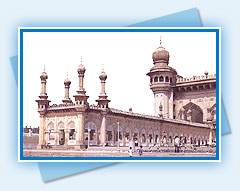
Mecca Masjid is one of the largest mosques in India accommodating upto 10,000 worshippers. This is the biggest mosque in Hyderabad and lies within hundred yards to the southwest of Charminar. The mosque got its name from the belief that the bricks inserted over the central arch were baked out of clay brought from Mecca, and also from the grand mosque at Mecca on which it is patterned. The constructions of this mosque was started by Sultan Muhammad Qutub Shah, the work continued during the reign of Abdullah Qutub Shah and Abul Hassan Tana Shah and was completed in 1694 by the Mughal Emperor Aurangzeb.
The hall measures 67m by 54m and is 23m in height. Fifteen arches, five on each of the three sides, support the roof. The western side is blocked by a high wall to provide the 'mehrab'.
A room in the courtyard is believed to house the relic of the Prophet Mohammad. At each end are two huge octagonal columns made out of a single piece of granite each topped by an arched gallery that is crowned by a dome. The colonnades and door arches have inscriptions from the Quran. Now it has been wire meshed to stop birds nesting in the ceiling and liming the floor. It took about 8000 Masons and laborers and 77 years to complete.
-
How to get there ?
Air - Hyderabad being the capital city is well connected by air from all the important cities of the country.
Rail - Hyderabad has got its own railhead and is connected with all the major cities within the state and outside.
Road - Regular bus service connects Hyderabad with all the important places within the country. For city transportation city buses, taxis, and auto rickshaws are also available.
- The driver Krishna was outstanding, polite, well-dressed and very patient. The road conditions were hazardous at times, but he negotiated them very capably. This is the second time I have used your company and I am extremely satisfied with your service. I will continue to recommend your company to colleagues visiting India and will be in touch for my next trip.......said Randy Bindra, USA travelled through us from 04 Mar. to 09 Mar. 2013
- We would like to thank you and your colleagues for a very well organised three week holiday. We thoroughly enjoyed it and everything worked very well. The overnight on the houseboat was a wonderful experience, it was such a change from being on the busy road, and to have the peace, silence and tranquillity for nearly 24 hours was indeed very nice. So, we can also recommend that and the two crew were very good indeed, and we thoroughly enjoyed the meals they provided for us. It was really good experience..........said Ketty Tomes, UK travelled through us from 28 Jan. to 17 Feb. 2013
- Thank you very much for great trip in India. My 4th trip to India has made that I’m more addicted to India than I was before (I thought that I couldn’t be more addicted but I was wrong). I tell only positive things to all my friends about my trip and TSI. Maybe my girl friend decides to visit South India with 3 other girls. I also look forward to visit Ladakh and Kashmir.........said Robert, Poland travelled through us from 29 Jan. to 13 Feb. 2013
- Dear Manoj,
Everyone is safely home again after our spice discovery tour, and we can definitely consider it one of our successes. Once again you won everyone’s hearts with your thoughtfulness and thoroughness in all our activities. I don’t know how we would have coped with the flight cancellations between Udaipur and Madurai if you had not been there to sort it out! ..............said Liz and Ian, Australia travelled through us from 13 Jan. to 29 Jan. 2013 - Dear Manoj,
Our tour of your wonderful country was fantastic. I was returning, after 36 years, but it was Helen’s first time and she loved every minute of the amazing journey. Our precious eighteen days seemed to stretch—there was so much to see and do! Each night we went to bed tired, and occasionally exhausted. And so, we really appreciated the extra effort made by all the Indian hotels to provide us with additional length in our double beds. Thanks you for making those arrangements. We were always very comfortable at night so we woke up refreshed, ready to enjoy the delights of the next day.........said Helen & Richard Walker, Australia travelled through us from 13 Jan. to 29 Jan. 2013 - We just want to thank for the amazing service provided to us. We are very happy and impressed with all assistance and support you gave us during the whole trip......said Manha Cleusa, Brazil travelled through us from 22 Oct. to 02 Nov. 2012
- We have enjoyed our trip to India and will certainly recommend TSI to any friends who wish to visit your beautiful country.....Dr. Chanvit, Thailand travelled through us from 11 Feb. to 20 Feb. 2012
India Tour Packages